
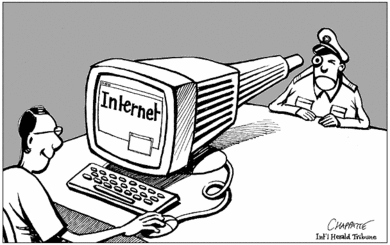
The feudalisation of the internet is an issue of much debate
amongst scholars and passionate users of technology alike. However, it could
also be argued that this seamless transition is going unnoticed by a large
percentage of users with many too young to know any better. The basic idea
revolves around the internet reverting back to a centralised network. The
central network comprises of multiple terminals that are connected to one ‘mainframe’
computer (Mitew 2013). This model has since developed into a ‘distributed
network’ which means the terminals are all connected to each other with no central
computer (2013). While the internet
enjoyed a period of free-flowing information, Ted Mitew compares today’s
digital environment to a feudal society whereby ‘users are technically speaking
free, but content industries control all aspects of information use’ (2013).
Based on the ideas of Mitew (2013), Zittrain and Doctorow
(2011), I can definitely see a huge power shift between users and content
industries in favour of the latter. In terms of reverting back to a centralised
network, instead of one mainframe computer, there are now many; each
represented by a content industry. For example, Facebook could represent one of
these ‘mainframe’ computers. As within a feudal society, users are nominally
free but realistically, Facebook will dictate what you do within their ‘walls’
(Mitew 2013). Apple could represent another mainframe computer, showing their
power by ‘locking down’ generativity within their products (Doctorow 2011). The
most alarming development for me is the idea of ‘tethered appliances’. Put
simply, tethered appliances are always connected to their vendors (Zittrain).
Companies such as Tivo and Apple have the power to access and change the
product from remote locations and that only scratches the surface of their power.
It could be argued that this transition makes using
technology easier, more convenient and even safer, but I can’t help but feel
powerless. I don’t like the idea of living in a feudal society; even if it is a
metaphorical one.
References
Doctorow
2011, ‘The coming war on general-purpose computing’
Mitew 2013 The Feudalisation of the Internet, lecture,
BCM310, Emerging Issues in Communications and Media, University of Wollongong,
delivered 29 May 2013.
Zittrain,
'Thethered Appliances, Software as Service, and Perfect Enforcement'. In The
Future of the Internet and How to Stop it, Yale University Press, New Haven,
ppp.101-126; [URL: http://futureoftheinternet.org/static/ZittrainTheFutureoftheInternet.pdf]

No comments:
Post a Comment