
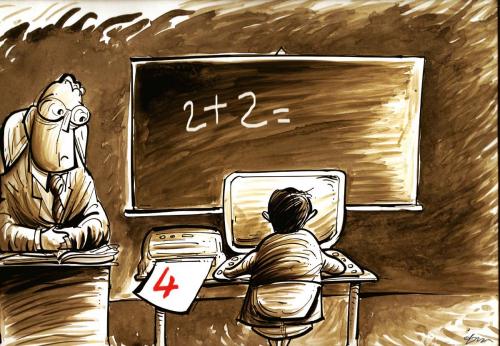
I can confidently say that I have experienced two completely
different types of education in my life. My primary and high school education
was basically technology free. My primary school had one computer. My high
school work was done in books because none of my classes had computers in them
and laptops cost a fortune. My first mobile was not a smartphone, rather a
Nokia “brick” that had two functions; call and text. This wasn’t that long ago.
I graduated in 2003 and as I write this I feel like I graduated in 1983. My
high school experience was much like the one described by Miller (2010). I read
‘To Kill a Mockingbird’ and can’t recall one current event being brought up in
any of my classes. I never really thought about it until now, but a lot of my
high school literature was out-dated and irrelevant.
After my 7 gap years, I enrolled into a digital communications
major at uni and got my mind blown. Technology was everywhere. The coordinator
of many of my subjects was Ted Mitew, a technology evangelist much like Miller.
He created his own way of teaching and learning through the use of blogs,
twitter feeds and other social networks. This could be compared to Arvanitakis’
use of MySpace at the University of Western Sydney (2009). I did, however,
learn that this style of teaching had not spread to all faculties of the
university. I would move from Mitew’s class to a curriculum and teacher that was
(as Miller would put it) frozen in time. I recognize that both style of
teaching have advantages and limitations, but considering the mind-frame and
skill-set of today’s students, it isn’t crazy to argue that more teachers
should adopt a more “Mitew-esk” approach. Maybe not to the extent of Millers vision
of a multimedia visual essay (2010), but at least catch up a little bit.
References
Miller, R (2010) ‘The Coming Apocalypse’, Pedagogy Winter 2010 10(1): 143-151
Arvanitakis, J (2009) ‘The Autonomous University and the Production of the Commons, or, “Pirates were like Ninjas, they Learned to Use their Environments”’ in Toward a Global Autonomous University (eds) The Edu-factory collective, Autonomedia New York pp 154 – 156

No comments:
Post a Comment