Tuesday, April 30, 2013

THE iMANOR


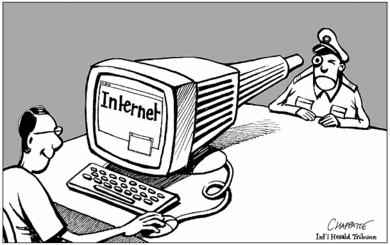
The feudalisation of the internet is an issue of much debate amongst scholars and passionate users of technology alike. However, it could also be argued that this seamless transition is going unnoticed by a large percentage of users with many too young to know any better. The basic idea revolves around the internet reverting back to a centralised network. The central network comprises of multiple terminals that are connected to one ‘mainframe’ computer (Mitew 2013). This model has since developed into a ‘distributed network’ which means the terminals are all connected to each other with no central computer (2013).  While the internet enjoyed a period of free-flowing information, Ted Mitew compares today’s digital environment to a feudal society whereby ‘users are technically speaking free, but content industries control all aspects of information use’ (2013).

Based on the ideas of Mitew (2013), Zittrain and Doctorow (2011), I can definitely see a huge power shift between users and content industries in favour of the latter. In terms of reverting back to a centralised network, instead of one mainframe computer, there are now many; each represented by a content industry. For example, Facebook could represent one of these ‘mainframe’ computers. As within a feudal society, users are nominally free but realistically, Facebook will dictate what you do within their ‘walls’ (Mitew 2013). Apple could represent another mainframe computer, showing their power by ‘locking down’ generativity within their products (Doctorow 2011). The most alarming development for me is the idea of ‘tethered appliances’. Put simply, tethered appliances are always connected to their vendors (Zittrain). Companies such as Tivo and Apple have the power to access and change the product from remote locations and that only scratches the surface of their power.

It could be argued that this transition makes using technology easier, more convenient and even safer, but I can’t help but feel powerless. I don’t like the idea of living in a feudal society; even if it is a metaphorical one.

References
 
Doctorow 2011, ‘The coming war on general-purpose computing’
 
Mitew 2013 The Feudalisation of the Internet, lecture, BCM310, Emerging Issues in Communications and Media, University of Wollongong, delivered 29 May 2013.

Zittrain, 'Thethered Appliances, Software as Service, and Perfect Enforcement'. In The Future of the Internet and How to Stop it, Yale University Press, New Haven, ppp.101-126; [URL: http://futureoftheinternet.org/static/ZittrainTheFutureoftheInternet.pdf]

Thursday, April 18, 2013

MY TWO EDUCATIONS


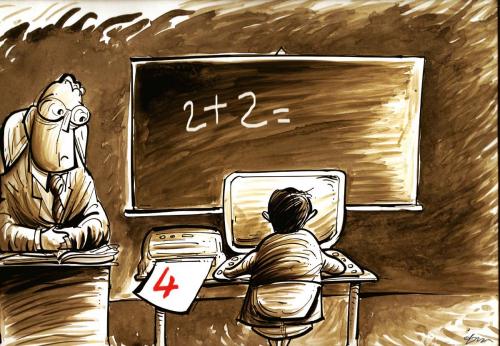
I can confidently say that I have experienced two completely different types of education in my life. My primary and high school education was basically technology free. My primary school had one computer. My high school work was done in books because none of my classes had computers in them and laptops cost a fortune. My first mobile was not a smartphone, rather a Nokia “brick” that had two functions; call and text. This wasn’t that long ago. I graduated in 2003 and as I write this I feel like I graduated in 1983. My high school experience was much like the one described by Miller (2010). I read ‘To Kill a Mockingbird’ and can’t recall one current event being brought up in any of my classes. I never really thought about it until now, but a lot of my high school literature was out-dated and irrelevant.

After my 7 gap years, I enrolled into a digital communications major at uni and got my mind blown. Technology was everywhere. The coordinator of many of my subjects was Ted Mitew, a technology evangelist much like Miller. He created his own way of teaching and learning through the use of blogs, twitter feeds and other social networks. This could be compared to Arvanitakis’ use of MySpace at the University of Western Sydney (2009). I did, however, learn that this style of teaching had not spread to all faculties of the university. I would move from Mitew’s class to a curriculum and teacher that was (as Miller would put it) frozen in time. I recognize that both style of teaching have advantages and limitations, but considering the mind-frame and skill-set of today’s students, it isn’t crazy to argue that more teachers should adopt a more “Mitew-esk” approach. Maybe not to the extent of Millers vision of a multimedia visual essay (2010), but at least catch up a little bit.

References

Miller, R (2010) ‘The Coming Apocalypse’, Pedagogy Winter 2010 10(1): 143-151

 Arvanitakis, J (2009) ‘The Autonomous University and the Production of the Commons, or, “Pirates were like Ninjas, they Learned to Use their Environments”’ in Toward a Global Autonomous University (eds) The Edu-factory collective, Autonomedia New York pp 154 – 156

Thursday, April 11, 2013

THE FUTURE OF MUSIC JOURNALISM


Traditionist View
The future of journalism is the subject of much debate among scholars and people within the industry. The introduction of new media, user generated content and citizen journalism is creating pro-am relationships within the journalism industry whether they like it or not. Thorsten Quandt (2011) discusses the concept of participatory journalism and the opinions of those affected in his article “Understanding a new phenomenon: the significance of participatory journalism”. While opinions vary between ‘traditionalists’ and ‘evangelists’, I agree with Quandt that, at least from a conceptual level, a combination of user-generated content and mass media communication offers the best of both worlds (2011).

In either case, it is hard to ignore the impact of participatory journalism on social trends and opinion. A particularly interesting example was raised by Marcus O’Donnell in a lecture on the future of journalism (2013). A relatively unknown Sydney based band reached No.1 in the iTunes charts and No.3 in the ARIA charts without any help from the mainstream ‘traditional media’ (Vincent, P 2013). Hindered by the un-marketability of their heavy metal genre, the band launched a clever social media campaign with the help of other, more established bands to achieve their goals. This is an encouraging development in music marketing for independent artists. In the pre-new media world of music, mainstream media dictated the direction of popular culture which made it very difficult for new artists to break onto the scene. As an independent artist myself, this development is both encouraging and disheartening. On the one hand, I have the ability to potentially reach millions of people for free. On the other, I am not the only person that has realised this and the level of competition has reached staggering levels.

As I have a particular interest in this area, I have chosen to research the future of music journalism in greater depth for my project.

Peace out.


References

Quandt, T 2011 ‘Understanding a new phenomenon: the significance of participatory journalism’ Chapter 9 in Hermida et al Participatory Journalism, Wiley Blackwell pp155-176

Vincent, P 2013 “Singular focus puts Northlane in fast lane”, The Sydney Morning Herald, April 6, accessed on 12/4/2013, http://www.smh.com.au/entertainment/music/singular-focus-puts-northlane-in-fast-lane-20130405-2hbyv.html